Friday, 15 November 2024

Thinking activity of Hamlet from the lens of Cultural Studies

Exploring Marginalization in Shakespeare’s Hamlet and Stoppard’s Rosencrantz and Guildenstern Are Dead


This blog is a part of thinking actvity assigned by DR. Dilip Barad sir. In this blog I'll be dealing with the exploration of marginalised characters in Hamlet and Stoppard's works. for more information you can visit Teachers blog

of power and systemic marginalization, drawing connections to modern-day corporate
hierarchies

The New Historicist approach within cultural studies focuses on analysing power struggles throughout history, often exploring themes like class conflicts, power dynamics, and political tensions. This lens can be applied to Shakespeare's ‘Hamlet’, where we see these struggles between characters of different social classes, particularly between the elite figures, like Hamlet and Claudius, and the lower-class characters, such as Rosencrantz and Guildenstern.


Marginalisation in Hamlet


Describe how Rosencrantz and Guildenstern represent marginal figures in Hamlet. How does Hamlet’s reference to Rosencrantz as a “sponge” reflect their expendability in the power dynamics of the play?  


Rosencrantz and Guildenstern are minor characters in the play who mainly serve to move the plot forward. While they have a few lines, they are easily forgotten by most readers, overshadowed by more prominent figures like Hamlet, Claudius, and Polonius. Despite being Hamlet's former university friends, they are largely dismissed due to their lower status in the court hierarchy.


When Claudius ordered them to spy on Hamlet, their role remained insignificant, as they lacked the power or understanding to influence the events around them. They try to gain favor with the king, but they are too innocent to grasp the true nature of the situation. Hamlet himself describes them as "sponges," who absorb the king's attention until they are no longer needed. In the end, their deaths highlight how those in power use and discard the less powerful, underscoring the ruthlessness of political and social hierarchies.Ultimately, the news comes that Rosencrantz and Guildenstern have been killed in England, illustrating how they were expendable pawns in the political game.


These two characters come from a marginalised position in the court, working for those in power without much personal agency or influence. They are caught in the power struggles of the ruling class and, in the end, meet their untimely deaths despite not having committed any wrongdoing. 


Modern Parallels to Corporate Power


The fate of Rosencrantz and Guildenstern in ‘Hamlet’ reflects the experiences of modern workers in today’s corporate world, especially during times of downsizing or globalisation. In the play, Rosencrantz and Guildenstern are manipulated and used by both Hamlet and Claudius, only to be discarded once they no longer serve a purpose. This mirrors the "Hire and Fire" policies in modern corporations, where employees are exploited for their labour and contributions to a company’s profits. Once they are no longer seen as useful, they are let go without a second thought.


Many workers today spend long hours, often over twelve hours a day, at their jobs, but end up feeling alienated from their families and even from their own lives. Like Rosencrantz and Guildenstern, they find themselves caught in larger systems of power, whether it’s global competition or corporate restructuring without the ability to control their fate.


Just as Rosencrantz and Guildenstern are used by Hamlet and Claudius, modern workers are often treated as mere cogs in the corporate machine, with little regard for their individuality or well-being. In both cases, profits take precedence over human lives. Workers, like the characters in *Hamlet*, are seen as expendable pawns in a larger system, whether in political struggles or the world of global capitalism.


Existential Questions in Stoppard’s Re-interpretation  


In ‘Rosencrantz and Guildenstern Are Dead’, Tom Stoppard takes the marginalisation of these two characters from ‘Hamlet’ deepens it by exploring their search for meaning in a world that seems indifferent to their existence. When Hamlet says, “they were not near my conscience,” he shows his disregard for Rosencrantz and Guildenstern, emphasising how easily they are forgotten. This mirrors the reality of today’s corporate world, where employees often feel invisible to company owners, much like Rosencrantz and Guildenstern are to Hamlet.


Published in 1966, ‘Rosencrantz and Guildenstern Are Dead’ comes at a time when post-war disillusionment and technological progress were at their height. Writers like Albert Camus, Samuel Beckett, and Harold Pinter were exploring themes of fragmented identity, the absurdity of life, and the struggle to find meaning in a chaotic world. Stoppard, like these writers, places Rosencrantz and Guildenstern in an absurd world where they are not just ignored but trapped in a purposeless journey, heading toward the inevitable end of death.


Their situation reflects the lives of modern corporate workers, who often feel as though they are stuck in an endless cycle of work, with no clear purpose or escape. They work tirelessly for the benefit of the corporate system, but their own lives, identities, and needs seem irrelevant to those at the top. Like Rosencrantz and Guildenstern, they are marginal figures in a larger, indifferent system, ultimately controlled by forces beyond their reach.


Cultural and Economic Power Structures Compare Shakespeare’s treatment of power in Hamlet to Stoppard’s reimagining. How does each work critique systems that marginalise “little people”? How might Stoppard’s existential take resonate with contemporary issues of job insecurity and corporate control?


Shakespeare’s ‘Hamlet’ and Stoppard’s reimagining ‘Rosencrantz and Guildenstern Are Dead’ both explore power structures and how they marginalise those in lower social positions, but they do so in different ways. Shakespeare critiques the rigid class system and the control of power by monarchs, where characters like Rosencrantz and Guildenstern are used as pawns by those in authority, reflecting the exploitation of the lower classes by the ruling elite. In Hamlet’s world, the monarchy holds all the power, and Rosencrantz and Guildenstern, despite their noble connections, are still powerless in the face of royal agendas.


Stoppard’s ‘Rosencrantz and Guildenstern Are Dead, written in the postmodern era, shifts the focus to a more existential perspective. Here, the characters are not just manipulated by royalty but are trapped in an absurd, meaningless world, unable to escape their fate. This reflects the shift from the power of monarchies in Shakespeare’s time to the economic control wielded by multinational corporations in the modern world. In today’s society, these corporations hold significant power, dictating the lives of workers who, like Rosencrantz and Guildenstern, are seen as disposable.


In the modern corporate world, employees often face job insecurity, and many are treated like commodities rather than individuals. As in the world of Stoppard’s play, workers give their time and energy to build companies, but when they can no longer contribute, they are discarded without support or compensation.


In both works, the characters' struggles emphasise how those with power, whether monarchs or corporations exploit the labour and lives of the marginalised. While Shakespeare’s ‘Hamlet’ critiques the oppressive monarchies of the past, Stoppard’s reimagining captures the sense of existential powerlessness that modern workers feel under the control of corporate giants.


I hope this would be helpful,

Thank you.


Saturday, 9 November 2024

Bhav Spandan Youth Festival 2024

This blog is based on 32nd Youth Festival 2024, organised by Maharaja Krishnakumarsinhji Bhavnagar University on 17/18/19 October 2024. In this blog I'll be sharing my experience of the Youth Festival and be sharing about various events.

Inaugration Seremony


Kalayatra


Skit


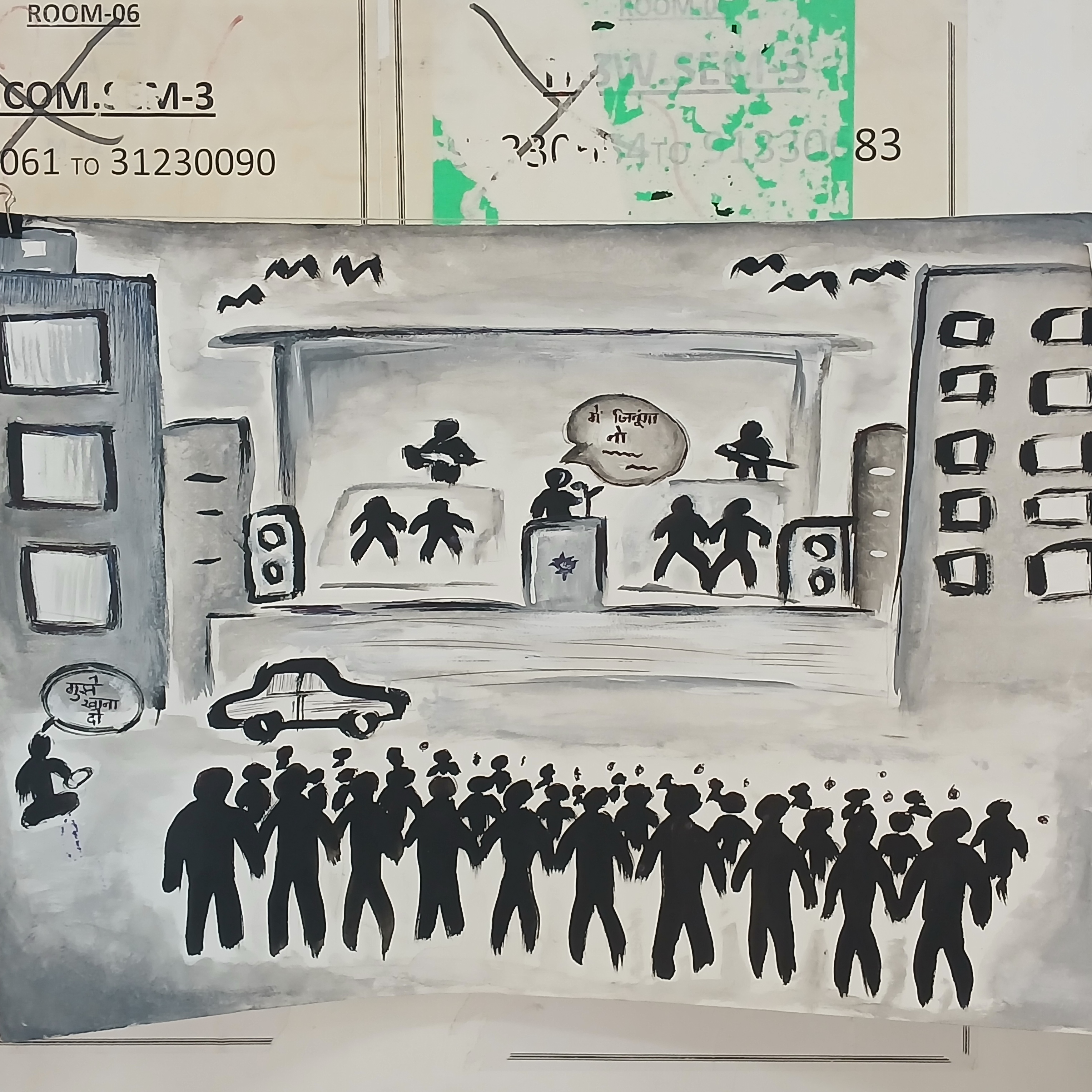
The skit covered a wide range of critical social issues, starting with unemployment, flaws in the educational system, and the complexities surrounding rape cases. It highlighted women's struggles and empowerment, depicted in Stree 3, and tackled the provocative question Gandhi Marte Kyun Nahi Hai. The message of unity was emphasized through Hum Sab 1 Hai (We Are All One), while corruption in employment and the move towards paperless transactions were also explored.

Elocution Competition 

  • Is suicide a solution?
  • My Gujarat
  • Exam

In this competition one of my classmate from the Department of English represented and she performed very well. 


On the spot Painting


Clay Modeling


Rangoli 


Poster making


Cartooning


Mimicry


One of my classmate also took part and represented Department of English. Those sounds include various vehicles, birds, insects, celebrities, door, bomb, cartoon characters, and many sounds from the surroundings. 


Poetry Recitation : which has following topics 

● વૃદ્ધ માબાપની વેદના 

● કાશ એવ ુંબને...કે- 

● હું એવો ગ જરાતી 

● દોસ્ત! ત ુંવાત તો કર 

● મારું ગામ ખાલી થઈ રહ્ ુંછે. 

● પ્રેમ એટલેકે- 


Sugam Geet, some of the tpoics are:

  • આવું શાને થાય છે
  • મહેકતી હવામાં કંઈક તો સમાયું છે
  • ગાતા ખોવાયું ગીત શોધો હવે કલરવની ભીડમાં
  • આખિર ઇસ દર્દની દવા ક્યાં છે
  • દિલ એ નદાન
  • કૌન રે છેડે ઓલા,તારે રે દરબાર મેઘરાણા
  • ઓ વાલમ તારી આંખોમાં ઉડે રંગ ફુવારા
  • કુચી આપો બાજી
  • સૂરજના અંધારે ગળેલી રાત
  • એક પથ્થરમાંથી બનાતા શિલ્પને અદર મળે, જો માથરું જીંદગીને તો જ નકાર મળે. 
Apart from this I was incharge as volunteer. Where I had a good experience of managing varoius tools and learnet organising skills.


The main motive behind this Youth Festival is all about the active learning of varoius skills. This time of the year for students, bring lot's of enthusiasm for adding more skill to their bucket list. 


Thank you. 

Tuesday, 5 November 2024

Franz Fanon’s 'The Wretched of the Earth'

This blog is a part of accademic work, in which I'll be dealing with the one of the well known Carribbean writer i.e Franz Fanon's " The Wretched of the Earth". In this discussion I'll be discussing some of the criticised and arguable questions. 

Overview of Franz Fanon


Frantz Fanon (1925–1961) was a psychiatrist, philosopher, and revolutionary from Martinique, a French colony in the Caribbean. He is best known for his work on the psychological effects of colonialism and his advocacy for revolutionary violence in the struggle for liberation. His writings have had a profound impact on postcolonial theory, critical race theory, and revolutionary thought.Fanon was deeply influenced by his experiences as a Black man from the Caribbean who lived in France and worked in Algeria during the Algerian War of Independence (1954–1962). His exposure to both European colonialism and the intense struggle for independence in Algeria shaped his critiques of colonialism, racism, and the social and psychological effects of imperial domination.

He also critiqued both colonial and postcolonial power structures, advocating for violent resistance as a means of psychological and physical liberation. His most significant works include Black Skin, White Masks (1952), where he examines the psychological impact of racism, and The Wretched of the Earth (1961), a groundbreaking study on the role of violence and national consciousness in the decolonization process.

The Wretched of the Earth

The Wretched of the Earth is Fanon’s most famous work and one of the seminal texts in postcolonial studies. Published in 1961, it explores the psychological, social, and political effects of colonization and the process of decolonization. The book is written in the context of the Algerian War of Independence, where Fanon was involved as a member of the National Liberation Front (FLN), and reflects his commitment to the revolutionary cause.

One of the central themes of The Wretched of the Earth is the idea that colonialism is maintained and perpetuated through violence. Fanon contends that the colonized people must engage in revolutionary violence to break free from the colonial order and restore their humanity. He argues that the colonized people are subjected to a process of internalized racism, which leads to self-hatred and alienation. Decolonization is as much a psychological process as it is a political one. He critiques nationalist movements that focus too narrowly on ethnicity or race and argues for a broader, more inclusive vision of liberation. He also critiques the elites in postcolonial societies who, rather than addressing the structural inequalities, may simply replace the colonizers and perpetuate old systems of power.


What is the role of violence in colonialism with reference to the wretched of the Earth?

In The Wretched of the Earth by Frantz Fanon, violence is a central theme and is depicted as both a tool of oppression and a force for liberation within the context of colonialism. Fanon explains that the colonial system is maintained through violence. Colonizers use military force, threats, and other forms of brutality to assert dominance and suppress resistance. Fanon also views violence as a means of reclaiming dignity and humanity. He argues that for the colonized people, responding to the violence of the oppressor through their own acts of violence becomes a way to break free from the psychological chains of subjugation. He asserts that decolonization, which seeks to replace the colonial order, is inherently violent because it disrupts a deeply entrenched system.The colonized subject is often dehumanized, leading to a fractured identity and internalized inferiority. Fanon suggests that the act of rebellion, even though violent, restores a sense of identity and agency to the oppressed.


Fanon’s first chapter, “Concerning Violence,” explicitly discusses how colonialism operates as a violent system. He explains that the colonized world is “compartmentalized” and characterized by stark binaries and oppressors and oppressed, colonizers and colonized—enforced by military and ideological violence. This division is maintained through violence, which becomes the language of power in colonial contexts.


 According to Fanon, what is wrong with the “racialization” of culture?

Fanon argues that racialization reduces culture to superficial characteristics based on racial or ethnic identity. This essentialist view suggests that people of a certain race or ethnicity have inherent, unchanging cultural traits. According to Fanon, this serves to dehumanize the colonized and supports the colonizers’ narrative of superiority. Racializing culture is a way for colonizers to exert control. By defining and reinforcing racialized differences, colonial powers create divisions among the colonized populations, making it easier to maintain dominance.


Fanon explains that during the struggle for liberation, the risk of racializing culture can lead to a narrow nationalism that excludes other voices and suppresses differences within the colonized community. This prevents the emergence of a true, unified national consciousness. He believes that an authentic culture should be inclusive and rooted in the shared experience of resisting oppression, rather than confined to racial or ethnic purity.

Write a short note on the title “The Wretched of the Earth”.

The title The Wretched of the Earth by Frantz Fanon is a powerful and evocative phrase that encapsulates the central themes of the book. It refers to the marginalized, oppressed, and impoverished people who have been subjugated and dehumanized by colonialism. The term "wretched" underscores the profound suffering and degradation experienced by the colonized, who are stripped of their dignity, autonomy, and humanity.


Fanon chose this title to highlight the stark realities of colonial oppression and the urgent need for liberation. The phrase itself is a call to acknowledge the plight of these disenfranchised masses and to recognize their potential as agents of revolutionary change. In the book, Fanon argues that decolonization must be a complete and violent overthrow of the colonial system, led by these very "wretched" individuals. He believes that their struggle and resistance can lead to the creation of a new social order that restores their humanity and transforms society.

The title also evokes a sense of solidarity and collective identity among the oppressed, emphasizing that their shared experience of suffering can unite them in their fight for freedom and justice. It points to Fanon’s broader message that the liberation of the colonized requires not only the end of political control but also a deep psychological and cultural transformation to rebuild their self-worth and reclaim their future.

Conclusion

Frantz Fanon's The Wretched of the Earth presents a radical critique of colonialism, emphasizing the role of violence in both the maintenance of colonial power and the liberation of the oppressed. By highlighting the psychological and physical scars left by colonial domination, Fanon stresses that true decolonization involves not just political independence but also a profound cultural, psychological, and social transformation. The concept of "racialization" is critiqued for reducing complex identities to simplistic and oppressive categories, which further entrenches the colonial system of control. Ultimately, Fanon’s work remains a foundational text for understanding the complexities of colonial power, resistance, and the necessary struggles for liberation and self-determination in the face of enduring oppression.

Refrences

https://www.jstor.org/stable/20024388


https://www.britannica.com/topic/The-Wretched-of-the-Earth

I hope this would be helpful

Thank you.


Sunday, 27 October 2024

"Lakshman" Poem by Toru Dutt

This is a blog task is a part of accademic work. In this blog I'll be dealing with the poem of Toru Dutt "Lakshman", with some of the interesting questions to deal with. 

Toru Dutt's Poetry

Toru Dutt, a remarkable poet, was a bridge between cultures and eras. Her poetry reflects the complexities of her identity, caught between Indian and European influences, Hindu and Christian beliefs. She skillfully blended these diverse elements, creating a unique literary voice.

In her famous retellings of Indian legends, such as "Sita," "Buttoo," and "Lakshman," Dutt breathed new life into ancient stories. She didn't merely translate these tales; she adapted them to English verse forms, infusing them with personal touches and contemporary themes. For instance, in "Buttoo," she added elements of class tension and rejection, making the story more relatable to her English-speaking audience.

Dutt's poetry also delved into her personal experiences and reflections on life. Poems like "Our Casuarina Tree," "The Tree of Life," and "Baugmaree" explore the interplay of cultures and religions in colonial India. In "Our Casuarina Tree," she contrasts the English landscape with the enduring memory of her childhood tree, highlighting her unique perspective as a poet straddling two worlds. Similarly, "The Tree of Life" blends Indian and Christian imagery, symbolizing the interconnectedness of different beliefs.

Dutt's first collection, "A Sheaf Gleaned in French Fields," showcases her multilingual abilities and her deep connection to nature. Her translations of French poetry reveal her Romantic sensibility, characterized by a fascination with the natural world and a sense of loss and longing. Unlike many Romantic poets, Dutt's portrayal of nature is multifaceted, reflecting her personal experiences and philosophical insights.

Beyond her cultural and literary significance, Dutt was also a pioneering woman writer. Her translation of Clarisse Bader's work on Indian women and her exploration of female experiences in poems like "Sita" highlight her feminist consciousness.

Toru Dutt's poetry is a testament to her extraordinary talent and her unique perspective. She seamlessly blended Eastern and Western influences, personal experiences and cultural traditions, to create a body of work that continues to resonate with readers today. Her legacy as a poet, a cultural bridge, and a feminist voice endures, making her an important figure in both Indian and world literature.

Lakshman

Toru Dutt's "Lakshman" is a poem that talks about a pivotal moment from the Hindu epic Ramayana. It focuses on the dialogue between Sita and Lakshman, highlighting Sita's growing impatience and frustration as she urges Lakshman to go to Rama's aid.

The poem begins with Sita expressing her concern for Rama's safety after hearing his voice calling out in distress. She questions Lakshman's inaction, accusing him of cowardice and even suggesting a hidden motive behind his reluctance. Sita's words are sharp and direct, revealing her growing anxiety and desperation. Lakshman, on the other hand, remains calm and composed. He assures Sita of Rama's invincibility and explains that he is protecting her as per Rama's orders. However, Sita's persistence and accusations eventually wear him down.

The poem reaches at peak when in the poem, Lakshman drawing the famous Lakshman Rekha, a protective line around their hut, before leaving to rescue Rama. This act symbolises his love and devotion to Sita, as well as his unwavering duty to his brother. The poem is a powerful and thought-provoking poem that offers a fresh perspective on a well-known mythological tale. It highlights the complexities of human emotions and the enduring power of love and duty.


Do you think the character of Sita portrayed by Toru Dutt in her poem Lakshman differs from the ideal image of Sita presented in The Ramayana?


Toru Dutt's portrayal of Sita in her poem "Lakshman" does differ from the traditional image of Sita presented in the Ramayana. While the Ramayana depicts Sita as an ideal woman, embodying virtues like purity, patience, and devotion, Dutt's Sita is more complex and nuanced. We can observe some differences which I'll be discussing below:

In the Ramayana, Sita is often portrayed as an almost divine figure, above human emotions and shortcomings. However, Dutt's Sita is more humanized. She displays emotions like anger, frustration, and a sense of vulnerability. Her dialogue with Lakshman reveals a woman who is not always patient and understanding, but also capable of expressing her discontent.While the Ramayana portrays Sita as a submissive wife, Dutt's Sita questions Lakshman's authority and his decision to leave her alone in the forest. She challenges his logic and expresses her fears openly. This challenges the traditional image of Sita as a passive figure who accepts her fate without question.

Dutt's Sita is not just a victim of circumstances. She is a complex character with a range of emotions. Her anger and frustration are understandable given her situation. She is not merely a symbol of virtue but a real woman with real feelings.Dutt's poem delves into the psychological depths of Sita's character. It explores her fears, anxieties, and doubts. This psychological exploration adds depth and complexity to her character, making her more relatable to the reader.

While these differences might seem to change from the traditional portrayal of Sita, they offer a more realistic and humanizing perspective. Dutt's Sita is not perfect, but she is relatable and believable. She is a woman who is struggling with her circumstances and trying to make sense of them. This portrayal challenges the idealized image of Sita and offers a more nuanced understanding of her character.

It is important to note that Dutt's interpretation of Sita is not a criticism of the Ramayana. Rather, it is a reinterpretation that reflects the changing times and evolving perspectives. By humanizing Sita, Dutt brings her closer to the reader and makes her a more relatable figure. This approach adds a new dimension to the understanding of the epic and its characters.


Write a critical note on Toru Dutt’s approach to Indian myths.

Toru Dutt, a 19th-century Indian poet, was a fascinating figure who straddled two worlds: the traditional Indian and the modern Western. Her work reflects the complex interplay of these cultures, particularly the influence of Christianity on her worldview and writing.Toru Dutt's approach to Indian myths is a fascinating blend of reverence and critical distance. She was deeply drawn to the rich tapestry of Hindu mythology, immersing herself in Sanskrit texts and reimagining these tales in English verse. Her "Ancient Ballads and Legends of Hindustan" is a testament to her profound engagement with these myths.  

However, her perspective is also shaped by her Christian upbringing and exposure to Western literary traditions. While she celebrates the beauty and power of these ancient stories, she does not shy away from critiquing certain aspects, particularly those that perpetuate social inequalities or gender stereotypes. Her retelling of myths often subverts traditional interpretations, giving voice to marginalized characters and challenging patriarchal norms.  

For example, in her poem "Savitri," she reimagines the myth of Savitri and Yama, highlighting Savitri's agency and intelligence. She portrays Savitri not merely as a passive figure but as a woman who actively challenges the forces of death and destiny. This reinterpretation aligns with her feminist sensibilities and her desire to challenge the limited roles assigned to women in traditional Indian society.  

Toru Dutt's approach to Indian myths is both respectful and critical. She recognizes the enduring power of these stories while also recognizing their limitations. Her retellings offer fresh perspectives and challenge conventional interpretations, making her a significant figure in the history of Indo-Anglian literature.

conclusion

Toru Dutt's approach to Indian myths reflects her unique position as a cultural bridge between East and West. Through her poetry, she brought new life and depth to well-known stories, blending Indian traditions with Western literary forms and themes. Her interpretations did not merely echo the original tales but reimagined them, highlighting voices and emotions that traditional tellings often subdued. Dutt's work, marked by feminist undertones and humanizing character portrayals, adds complexity to figures like Sita and Savitri, showcasing them as multi-dimensional women with agency and emotional depth.This dual approach allowed her to challenge the patriarchal and social norms embedded in these stories, making her interpretations resonate with modern sensibilities. As a result, her legacy stands as a testament to her ability to weave together cultural and literary threads, producing works that continue to inspire discussions on identity, gender, and the reinterpretation of tradition in contemporary literature.

Refrences

 https://www.britannica.com/topic/Sita


https://www.slideshare.net/slideshow/toru-dutt-biography/255141295


https://www.gradesaver.com/toru-dutt-poetry/study-guide/summary-lakshman

I hope this would be helpful,

Thank you.


'Think it, Cite it, Write it: Plagiarism on Research Methodology'

This blog is a part of assignment topic ' Think it, Cite it, Write it: Plagiarism on Research Methodology' from paper no. 209 Resear...